Why make your own gas?
- Because fuel is too expensive
- Because self sustainability is important
- Because its clean and carbon neutral
- Because being prepared is responsible
- Because its a free energy source for many people
- Because its fun
- Because the future needs more energy sources
- Because it brings affordable energy to off-grid communities
There are many reasons to make your own fuel. The cost of all energy is increasing and the future is uncertain. Producing your own energy or acquiring the tools to do so means peace of mind, and it may also save you money.
What kind of gas are we talking about?
Unlinked Energy specializes in manufacturing simple products that allow you to make two types of flammable vaporous gasses: bio-gas and synthesis gas (syngas).
(Our filtration and storage products can also be used for many other applications and with most vaporous gasses, but they are primarily made for these two gasses).
Just like natural gas (which is not a gas that can be made affordably by an individual), bio-gas and syngas are mixtures of many other flammable vaporous gasses.
Here is a comparison of all three gasses:
Natural gas (not D.I.Y.)
Bio-gas
Synthesis gas (syngas)
Natural gas is primarily composed of methane (about 95%), along with small amounts of other hydrocarbons such as ethane, propane, and butane, as well as traces of carbon dioxide, nitrogen, hydrogen sulfide, and helium. It is a colorless and odorless gas, which is why an odorant is added for safety to detect leaks.
ENERGY CONTENT PER VOLUME:
950-1050 BTU/ft3 (British thermal units per cubic foot) or
278-307 Wh/ft3 (Watt hours per cubic foot)
Bio-gas is primarily composed of methane (typically 45% to 75% by volume) and carbon dioxide, with small amounts of hydrogen sulfide, moisture, and other gases. The exact composition can vary based on the type of organic material used and the conditions during its production.
ENERGY CONTENT PER VOLUME:
537-700 BTU/ft3 (British thermal units per cubic foot) or
157-205 Wh/ft3 (Watt hours per cubic foot)
Synthesis gas typically consists of 30 to 60% carbon monoxide, 25 to 30% hydrogen, 5 to 15% carbon dioxide, and up to 5% methane, with variations depending on the feedstock used, or in our case wood type (more about that later).
ENERGY CONTENT PER VOLUME:
120-400 BTU/ft3 (British thermal units per cubic foot) or
35-117 Wh/ft3 (Watt hours per cubic foot)
How these gasses are typically made/acquired (large scale):
The lower the energy content per volume of gas, the higher the amount of gas needed per unit of time in order to accomplish the same task.
So for example, if you wanted to run a natural gas engine on bio-gas, you would need to modify the engine to inject roughly 30% to 40% more gas into the combustion chamber. Or if you wanted to run a natural gas engine on syngas, you would need to modify the engine to inject roughly 60% to 80% more gas into the combustion chamber.
This might seem crazy to modify an engine like this, but remember, this is gas that you can make for free! Also, running an engine isn't the only use for this gas.
Natural gas
Bio-gas
Synthesis gas (syngas)
Natural gas is a fossil fuel that is formed when layers of organic matter (primarily marine microorganisms) are thermally decomposed under oxygen-free conditions, subjected to intense heat and pressure underground over millions of years. It's typically found deep under ground in caves and areas of shale rock, and usually accompanied by crude oil.
In order to harvest natural gas, you need millions of dollars in equipment and personnel to find and safely drill to the natural gas. Then you need another few hundred thousand dollars in surface equipment to safely handle and filter the high pressure gas. All this makes natural gas only viable for use/harvest by large companies.
Bio-gas is made using a device called a bio digester or bio reactor. Raw materials such as agricultural waste, manure, municipal waste, plant material, sewage, green waste, wastewater, and food waste are fed into the device. The raw materials are broken down through the process of anaerobic digestion, which creates biogas as a byproduct, and are released from the device after a period of typically 1 to 3 months.
The bio-gas produced is treated to remove toxic hydrogen sulfide. Sometimes the biogas is also treated further to remove carbon dioxide and other impurities in order to turn it into a gas most commonly referred to as renewable natural gas (RNG).
Syngas is a bit more complicated to explain because there are many different types of syngas that are produced in multiple ways.
Coal gas or town gas is a type of syngas made by super heating coal and water vapor in an oxygen deprived environment. It has mostly been used in the past as a way to heat homes in towns without access to natural gas.
Wood gas is another type of syngas that is made in a device called a wood gasifier, and was mostly used in the past to power vehicles in fuel deprived communities. It functions by burning wood in a low oxygen environment. Wood gas has a lower energy content then most other syngas types due to its high content of non flammable nitrogen.
How to simply and affordably make/filter/store bio-gas and syngas
Bio-gas
Here are the components you need to make, filter(scrub), and store bio-gas.
Note: A bio digester (bio-gas production system) only works at temperatures above 37*F or 3*C.
-Batch anaerobic bio digester
-Bio-gas scrubber
-Low pressure storage tank
First you need a bio digester, which makes the bio-gas. In our case the most simple type of bio digester is a batch bio digester. Make this with a 5 gallon bucket, a sealing lid, and a 3/8 barb to container adapter. Find all the details on how to install the adapter on the 3/8 barb to container adapter page. We also recommend painting your bucket black so it will warm itself in the sun, because a bio digester performs best in warm temperatures. The best temperature for bio-gas production (for fast, maximum production) is between 95*F or 35*C and 99*F or 37*C. As bio-gas is produced, the pressure will increase, pushing the gas to our next device. Will talk about what to fill the bio digester with later.
After the bio-gas is produced it will flow from the bio digester to the bio-gas scrubber. The bio-gas scrubber removes the toxic and corrosive hydrogen sulfide gas from the bio-gas, making it safe for use with engines and indoor stoves. Use our simple gas filter/scrubber for this task and fill it with iron or steel scraps, steel wool, steel scrubbing pads, or other iron products in order to allow the hydrogen sulfide to chemically react with the iron, which creates iron oxide (rust) and removes the hydrogen sulfide from the gas.
Finally, we need a place to store this gas. The gas must flow from the bio digester, to the scrubber, and then to the storage tank. Therefore, the storage tank must consistently stay at a relatively low pressure in order for gas to naturally flow into it. For this application we recommend a water sealed gasometer tank (also known as a gas holder, or simply a gasometer). Gasometer tanks are more durable and less prone to leaks than a balloon or gas bag, they self purge themselves of oxygen and cannot over pressurize, making them the safest option. For small scale systems, you could use a small gasometer tank that we manufacture, find them here. Or for a larger and more practical gasometer tank, you can make one yourself using our 3/8 barb to container adapter, 55 gallon barrel, and a 100 gallon collapsible rain barrel. Find out how to build it on our 3/8 barb to container adapter page.
All three components (batch bio digester, bio-gas scrubber, and low pressure storage tank) are connected using affordable 3/8" inner diameter ID vinyl tubing which you can find on Amazon.com, Walmart.com and at many hardware stores.
How to use a batch bio digester system
Place your bio digester outside preferably in a place where it will get a lot of sun. Then fill your batch bio digester with food scraps/waste, spoiled milk and juices (if available), grass, and animal manure. You're essentially trying to make the most disgusting smoothie you can, so mix it and add water if more liquid is needed. Then connect and seal the lid to your bucket and install your 3/8" inner diameter (ID) vinyl tubing. Over the next 1 to 3 months the bio digester will produce bio-gas. The amount of bio-gas a bio digester makes varies bases on many factors, but during its peak, expect your bio digester to make the same volume of gas per day as the size of your bio digester itself. With a 5 gallon bucket that might not be a lot, but this system can be scaled up by using many more 5 gallon buckets or even a 55 gallon barrel.
Note for professionals: With EXTREME CAUTION, bio-gas that is properly filtered and scrubbed can be compressed and stored in high pressure gas bottles in order to store a lot of gas in a smaller space. This is ideal for storage on vehicles which use the gas as fuel.
Note for farmers: A bio digester is especially useful for a farmer with livestock and a crop field. The manure that you typically use for fertilizer can be used in a bio digester to make bio-gas to run the farm, then after the digestion process, the remaining digestate inside the bio digester makes for even better fertilizer than it did as manure. Its a win win situation.
Synthesis gas (syngas)
Here are the components you need to make, filter, and store syngas.
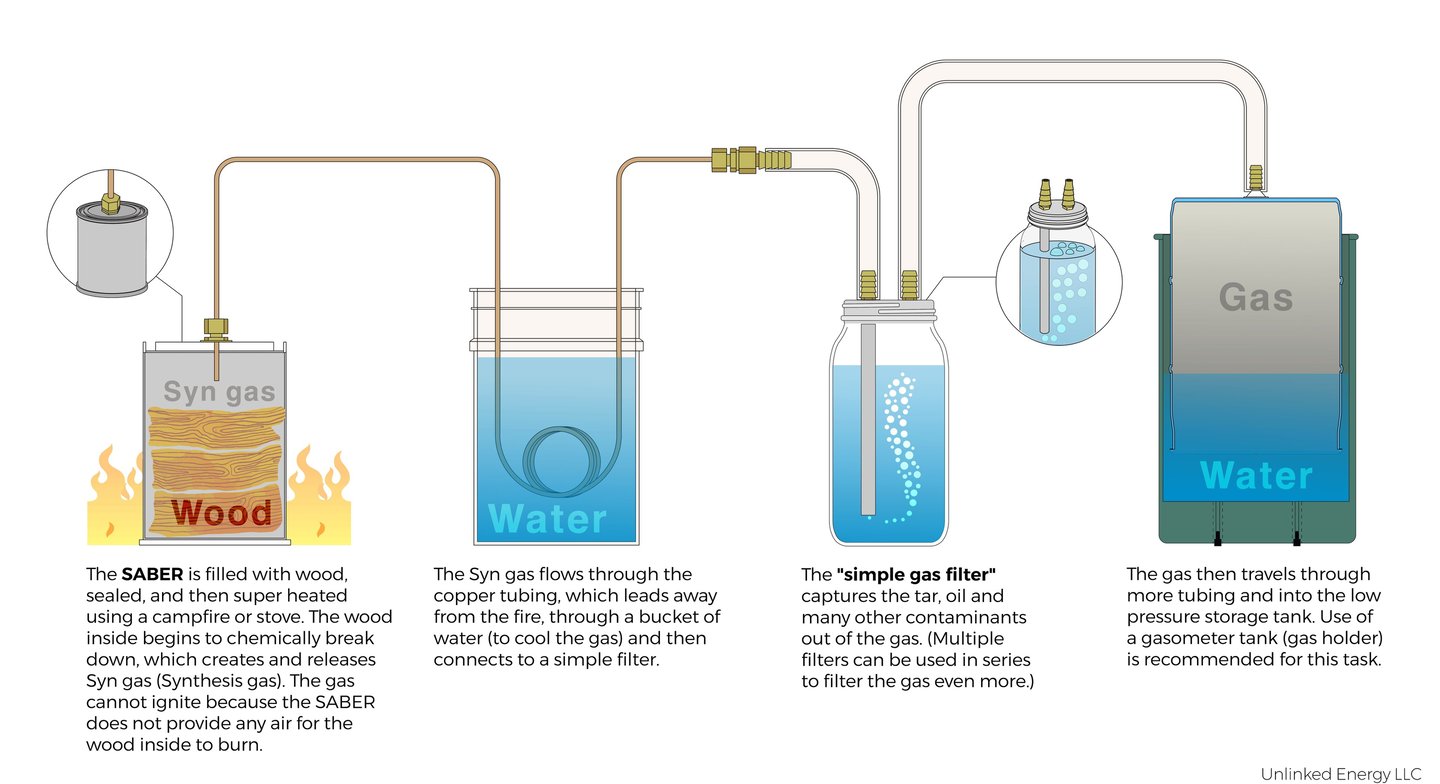
First, the device we will use to make our syngas is the SABER. The SABER allows you to super heat wood in an oxygen deprived environment (its reaction chamber), using a stove or campfire. Learn how the SABER works in detail on its product page. The syngas will then flow out of the reaction chamber and through the SABER's copper tubing, which cools the gas.
-Bucket of water
Unfortunately, the copper tubing alone is not enough to sufficiently cool the gas, so in order to increase its cooling potential, we will need to run a few feet of the copper tubing through a bucket of water. We recommend using a bucket that holds at least three gallons of water for this task. If you are producing syngas in temperatures below freezing, run your copper tubing through a pile of snow. The goal is to lower the temperature of the gas to below ~120*F or ~49*C before the next step.
Now that we have produced and cooled our syngas, we can now filter it. This is important because when syngas is produced from wood, it also produces other byproducts like oils, tars, and other contaminates, that would be harmful to a stove or engine. For this task we can use one or multiple (depending on how much filtering you require) of our simple gas filters, filled 90% with water. If you are producing gas in freezing temperatures, fill/pack the simple gas filter with grass clippings or any filter media that can reduce/capture smoke particles. Using a filter media other than water will required more than one simple gas filter to sufficiently filter contaminants. Connect the copper tubing from the SABER to the simple gas filter using 3/8 inch inner diameter (ID) vinyl tubing. Connecting one filter to another, and connecting the filter (or filters) to your storage tank, can also be done with the same tubing.
-Low pressure storage tank
We have produced, cooled, and filtered our syngas, now we need a place to store it. For this task we need a low pressure tank that will consistently stay at a low pressure throughout the production process. This is because in order for the gas to flow through the cooling and filtering system and into the tank, we need the tank to be at a lower pressure than the rest of the system. For this task we recommend a water sealed gasometer tank. Gasometer tanks are more durable and less prone to leaks than a balloon or gas bag, they self purge themselves of oxygen and cannot over pressurize, making them the safest option. You can build a large, practical gasometer tank using our 3/8 barb to container adapter, 55 gallon barrel, and a 100 gallon collapsible rain barrel. Find out how to build it on our 3/8 barb to container adapter page. If you are producing syngas in freezing temperatures, unfortunately a water sealed gasometer tank will not work for you, as these tanks use liquid water for operation. So the next best storage tank will likely be a gas bag. Gas bags are more expensive than building a gasometer tank, so alternatively you could use a inflatable object, such as a air mattress, to store your gas using our 3/8 barb to inflatable adapter. You must use EXTREME caution when using gas bags or inflatables to store gas, making sure to remove ALL air (oxygen) from the gas bags/inflatables before injecting them with flammable gas, or you will risk an explosion hazard!
How to use a syngas (SABER) production system
Fill the SABER with wood (sticks, wood chips, saw dust, etc.) and seal the lid on top.
Important: Keep in mind, the faster the wood you put inside the SABER burns, the faster it will generate gas. If the wood inside is too small and generates gas too fast it could cause the SABER to over pressurize, which would make the lid pop off. In order to prevent this, we recommend loading the SABER with wood that is the perfect size for charcoal briquettes, or larger.
Now prepare your heating method.
In order to super heat the SABER (recommended temp: 800F or higher), use a stove or campfire. A camp fire is the most affordable option, but remember, only burn where and when permitted, when its safe to do so, and with enough water ready to put out a fire at least 2 times larger than planned.
Place the SABER into the center of your fire pit or onto a stove and carefully extend the copper tube, as to avoid kinks in the tube. If the tube is kinked by accident, simply bend both sides of the kink back into a straight position and use a pair of pliers to squeeze the tube back to a perfect round shape. Extended the copper tube at least a few feet away from the fire and direct a few feet, or several loops of the tube, through your bucket of water. Then direct the copper tube out of the bucket of water and connect the brass fitting to a piece of 3/8 inch inner diameter (ID) vinyl tube. The length of the tubing is up to you. Connect the tubing to your filter (or filters), but don't connect them to the storage tank yet. Connect the tank after production starts.
Your system should be ready to go, you can now start your stove or campfire. As the SABER begins to heat up, it will begin to drive out moisture from the wood, and you will initially see a lot of (dirty) water vapor forming and collecting in your system. After a few minutes, all air (oxygen) should be purged (pushed) out of the system and you can then connect your filter (or filters) to your storage system.
Depending on the size of your SABER, the amount and size of wood inside, the temperature that the SABER is heated to, and other factors, production of syngas will continue for anywhere between 30 minutes to 4 hours. If you are are not using a gasometer tank, make sure you are monitoring the amount of gas in your storage device so that it does not become over pressurized.
Once production of syngas is over, you can disconnect and cap/close your storage device, making sure not to let any air in, or release any gas out. Inside the SABER, you should be left with pure charcoal which can be used in charcoal grills, charcoal stoves, fertilizers, pyrotechnics, and can even be used to create even more gas.
We recommend letting the gas sit in your low pressure storage tank for a few hours or more, in order to allow some of the water vapor to settle. If you are using a water sealed gasometer tank to store your gas, the gas will be naturally filtering even more as it sits inside the tank.
IMPORTANT NOTE: Due to its high amount of carbon monoxide, syngas is only suitable for use in outdoor applications.
Note for professionals: With EXTREME CAUTION, syngas that is properly filtered (and possibly scrubbed to remove trace amounts of hydrogen sulfide), can be compressed and stored in high pressure gas bottles in order to store a lot of gas in a smaller space. This is ideal for storage on vehicles which use the gas as fuel.
Use of bio-gas and syngas
There are MANY ways to use bio-gas and syngas. Bio-gas can be used in all ways that natural gas can be used, sometimes with little modification needed. While the use of syngas on the other hand, because it's so much less energy dense than bio-gas or natural gas, typically requires you to modify equipment more significantly for its proper operation.
Special engine manifolds and stove adapters for use with bio-gas and syngas are still in development by Unlinked Energy, so adapting these gasses for use on this equipment is currently up to the community. It's important to mention that most engine intake systems and gas stoves are different. Modifications to these systems in order for them to run on bio-gas and syngas will take many different solutions. Thankfully, this concept isn't new. People have been converting stoves and engines to run on different fuels since these systems have been around. Information on how to convert these systems can be found all over the internet, and thankfully, now with the use of AI such as Grok or ChatGPT, finding specific modifications for your specific engine or stove is faster and easier than ever.